
Getting Rice County Court Records
Start with Kansas District Courts CaseSearch. That search gives you the Rice filing and case number. What the public sees there is case information, not necessarily every document on file. Need the official file, an inspection, or a copy? Contact Jane E. Hrabik, Clerk of the Court, at the Rice County District Court. Ask at the counter. Ask by mail. Phone works for routing help too. You can also use the email and delivery choices on the Kansas court-record request form.
Guests on CaseSearch see only the basic information the portal allows. Registered Smart Search and approved expanded-access tools require extra authentication. There is no bulk export, no promise of every document, and no full coverage of records created before the court's eCourt conversion. So a courthouse-terminal search and a clerk request remain essential fallback channels, not just copies of the website.
- Identify the Rice County case number, parties, approximate filing date, and exact document.
- Check CaseSearch, then choose inspection at the clerk's counter or a written mail or email request.
- State whether the request is for inspection, a plain copy, or a certified copy.
- Ask for an estimate when the request may require extensive staff time or many pages.
- Pay the assessed lawful charge and select mail, email, pickup, or fax where available.
Rice Court Records Inspection
Court records can be inspected at the clerk's office, according to the Rice District Court FAQ. The clerk can also arrange copies. You may get a call later when a file or copy is ready. Calling 620-257-2383 before a trip helps with an older file, a big request, or a record needing review.
Nothing online does not mean nothing exists. Older material may sit at a courthouse terminal. A paper or imaged file may hold it too. The public portal's coverage stops short of that.
Court Record Types
The district clerk holds records for state criminal, civil, domestic, probate, juvenile, and other district-court matters filed in Rice County. What you can get depends on the case type, the document, and any sealing or confidentiality rule.
- Case summaries and chronological docket entries
- Petitions, complaints, answers, motions, and notices
- Orders, judgments, sentencing entries, and dispositions
- Public portions of civil, domestic, probate, and criminal files
- Administrative orders and locally maintained court forms
Rice Court Records Source Preview
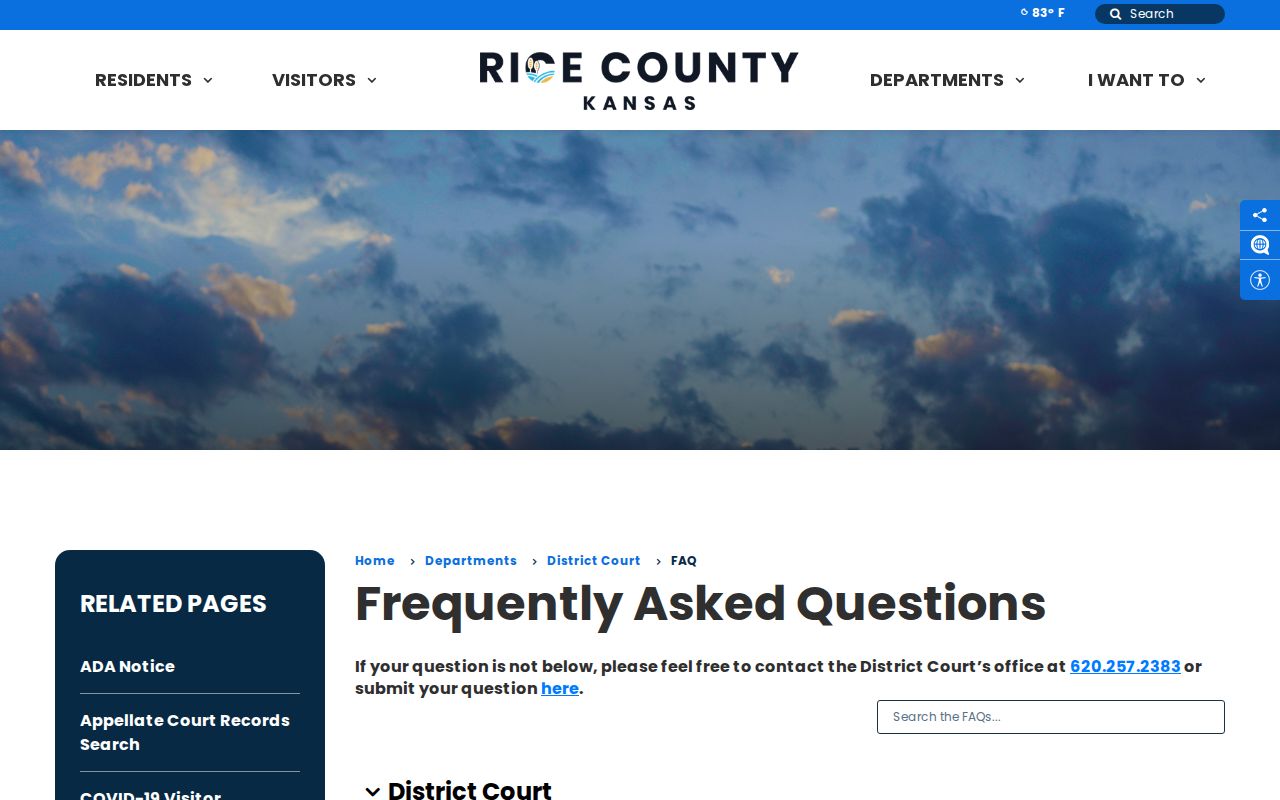
The official Rice District Court records FAQ spells out inspection and copy-request steps from the court itself.
Precise Rice Court Record Requests
The official KORA request form wants your contact information. It also wants a specific description of the records and a preferred response method. Good wording sounds like this: “Please provide a plain electronic copy of the order filed on [date] in Rice County case [number].” Missing the number? Give party names, case type, and an approximate year instead.
The form lists mail, email, pickup, and fax choices, with space for an estimated cost. It sets no universal fixed charge for every request.
Inside a Rice County Court Record
Think of the docket as the index and chronology. The case file holds the actual documents behind those entries. A search result may identify a filing without giving you the filing itself.
| Case Number | Kansas identifiers may appear as 2019CV25 or with a Rice location prefix such as RL2019CV25. |
|---|---|
| Pleadings | Petitions, complaints, answers, motions, and other filed papers. |
| Orders & Judgments | Signed rulings and final or interim decisions entered by the court. |
| Docket Sheet | A chronological list of filings, settings, actions, and dispositions. |
| Exhibits | Attachments may be filed, retained separately, restricted, or returned under court procedure. |
Four Rice Court Record Layers
Keep four products separate. They are a CaseSearch result, the clerk's docket or register, a filed document, and an official copy. A transcript is something else again. It comes through the court reporter, not by certifying the clerk's docket. Asking for “the whole record” can slow things down. Naming the exact layer makes a request easier to price and fulfill.
CaseSearch confirms the caption, court location, number, status, and whatever entries the public interface permits. The docket then gives you the sequence of court activity. A filed motion or order holds the actual text. It sits behind one docket entry. Certification authenticates the clerk's copy. It does not expand public access to a closed document. A transcript records spoken proceedings and normally takes separate court-reporter coordination. Need proof of a ruling? Identify the signed order rather than relying on a short docket description.
Fees and Certified Copies
A plain copy reproduces a public document. A certified copy carries the clerk's official certification. Rice materials list historical copy and fax charges, though they are not established as a current universal schedule. Kansas law permits reasonable fees tied to access and copies, so ask for a current quote before ordering.
| Item | Amount |
|---|---|
| Inspection at clerk counter | Confirm availability with clerk |
| Plain paper or electronic copy | Current clerk quote |
| Certified copy | Current clerk quote |
| Large or staff-intensive request | Request written estimate |
Rice County District Court Clerk
101 West Commercial, Third Floor
Lyons, KS 67554
620-257-2383
Older Rice Court Record Images
Rice County approved a Digital Reel imaging project in 2018. Kansas courts caution that records predating a court's eCourt conversion may not be online. When CaseSearch misses an older matter, ask the clerk about the courthouse terminal, archived images, paper files, and the right request route. The portal's coverage boundary is one thing. The clerk's retention of an official file is another.
Give the clerk a useful date range. A former party name, approximate year, case family, and known attorney can separate similarly named matters. The case number is still the strongest identifier. Never alter a location prefix like RL when copying a number from an order or notice. Say whether you just need to read an older image or want an authenticated copy. Those are different fulfillment tasks for the clerk.
Rice Probate Court Record Detail
A conservator's accounting form filed in Rice County probate court in 2025 proves a simple point. The docket line and the document behind it are not the same thing. The template itself captures the case caption, the reporting period, beginning and ending balances, receipts, disbursements, assets, liabilities, schedules, signatures, and verification. A docket entry may say only that an accounting was filed. Most of those details stay off the screen.
Partial access is common here. Probate and conservatorship filings often hold financial or personal information. That information demands review, separation, or redaction before release. So ask for the public portion of the specific filing by name. Do not assume every attachment comes out. When the clerk withholds or redacts something, ask which rule governs that portion. Ask whether a public version exists.
Estimate Rice Court Record Requests
K.S.A. 45-219 allows reasonable charges for access and copies. The official request form has an estimated-cost section. That field is a cue to define a broad request before staff starts work. A tight date range and named documents cut down the search, review, and copying burden. Get the clerk to state the expected charge and the delivery format, then approve the scope before anything is processed.
Older local administrative materials list copy and fax charges. Treat those as history, not a guaranteed price for today. The clerk's own response should settle the current cost, accepted payment methods, certification fees, and timing. This matters most for multi-volume files. It also matters for requests that need closure or redaction review first.
Sealed Records and Public Access
The Kansas Open Records Act sets a baseline right to inspect, and Kansas Supreme Court rules govern how court records reach the public through terminals and electronic access. Neither one makes everything public. A docket entry can appear in the open while the underlying file cannot, because sealed, expunged, juvenile, adoption, and sensitive probate material may be withheld or released only in redacted form.
Key Rules:
K.S.A. 45-218 establishes the public inspection framework.
K.S.A. 45-220 governs agency procedures for record requests.
K.S.A. 45-221 identifies exemptions and supports separation of public from closed material.